Thirty Seconds of Silence: What Your Stylist Knows About Your Hair Before You Speak
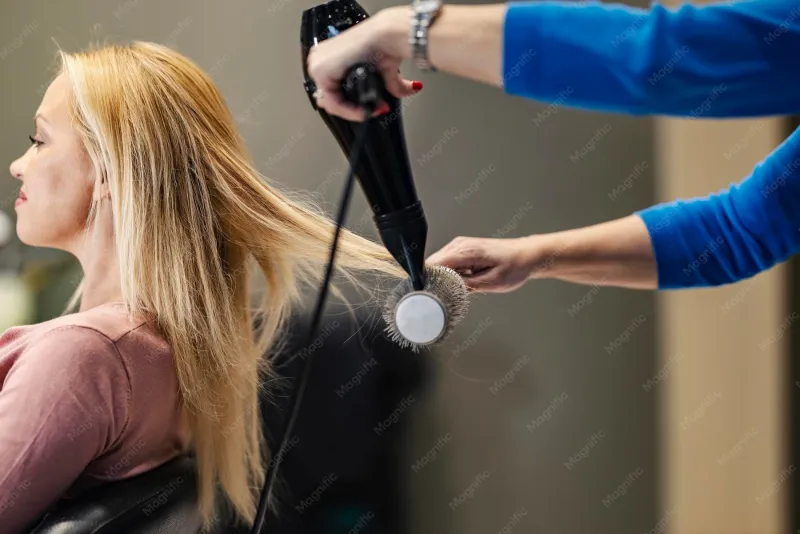
Photo: hairstylist examining client hair close up salon, via img.freepik.com
There's a moment that happens in every good salon, and most clients never notice it. You sit down. Your stylist drapes the cape, runs a hand through your hair, tilts your head slightly to one side. Maybe they lift a section at the crown, or pause for a beat at the nape of your neck. Nothing is said. But everything is being decided.
We spoke with stylists from Portland to Philadelphia, and they all described versions of the same thing: a silent, rapid-fire assessment that happens in the first half-minute — long before you've finished explaining the inspiration photo on your phone.
The First Read: Cowlicks Never Lie
"The crown tells me everything," says Marisol Vega, a stylist with fifteen years behind the chair in Austin. "A cowlick isn't a flaw. It's a set of instructions. If a client wants a blunt fringe but their cowlick spirals right at the hairline, I already know that fringe is going to fight them every single morning."
Cowlicks, whorls, and growth patterns are the first chapter of the story. Hair grows in directions set before you were born, and no amount of product will fully rewrite that script. A skilled stylist doesn't see these patterns as obstacles — they see them as the grain of the wood. Work with the grain, and the cut styles itself. Work against it, and you're signing your client up for a daily battle.
Density, Texture, and the Truth in the Ponytail
Next comes density — how many strands you're actually working with. Two clients can both say they have "thick hair" and mean completely different things. One has coarse strands, but fewer of them. The other has fine hair, but a lot of it. The difference determines everything from how aggressively to texturize to whether a bob will collapse into a triangle by week three.
"I always ask to see the natural texture, not the blowout," explains Devon Clarke, who works out of a studio in Brooklyn. "If someone comes in with three-day-old curls flattened by a flat iron, I'm not reading their hair. I'm reading their heat tool. I need to see what happens when that hair is left alone."
This is why many stylists ask clients to arrive with clean, product-free, air-dried hair before a big change. It's not fussiness. It's diagnostics.
Face Shape Is a Starting Point, Not a Verdict
You've probably seen the face-shape charts: oval gets everything, round gets layers, square gets softness. Working stylists treat those charts the way a jazz musician treats sheet music — as a reference, not a rule.
"Face shape is maybe ten percent of it," Vega says. "What matters more is proportion. Where's the widest point? Where's the jawline sitting? Does the client have a long neck or a short one? I'm looking for balance, not matching a template."
Add to that the details most of us never think about: a flatter crown on one side, an ear that sits slightly forward, a widow's peak that will shape how bangs fall. None of these are flaws. All of them are information.
What You Can Learn to Notice
Here's the empowering part: this kind of reading isn't a closed guild secret. You can develop your own eye for your hair, and it will make every salon conversation better.
Start with your cowlick — actually find it. Look at where your hair parts most naturally when you're not forcing it. Notice which side your hair falls when you wake up. Pay attention to how your hair behaves on day two versus day four. And if you're growing it out, notice where it gets stuck first. That's your growth pattern announcing itself.
Then, at your next appointment, ask your stylist what they see. Not "what should I do with my hair?" — but "what do you notice about how it grows?" You'll get a more useful answer than any Pinterest board can offer.
The Art in the Assessment
There's a reason the best cuts feel inevitable, like the hair was always meant to look that way. It's because they started with listening — not to the client's words, but to the hair itself. Every snip that follows is a response to that first silent conversation.
The scissors get the glory. But the reading? That's where the artistry begins.